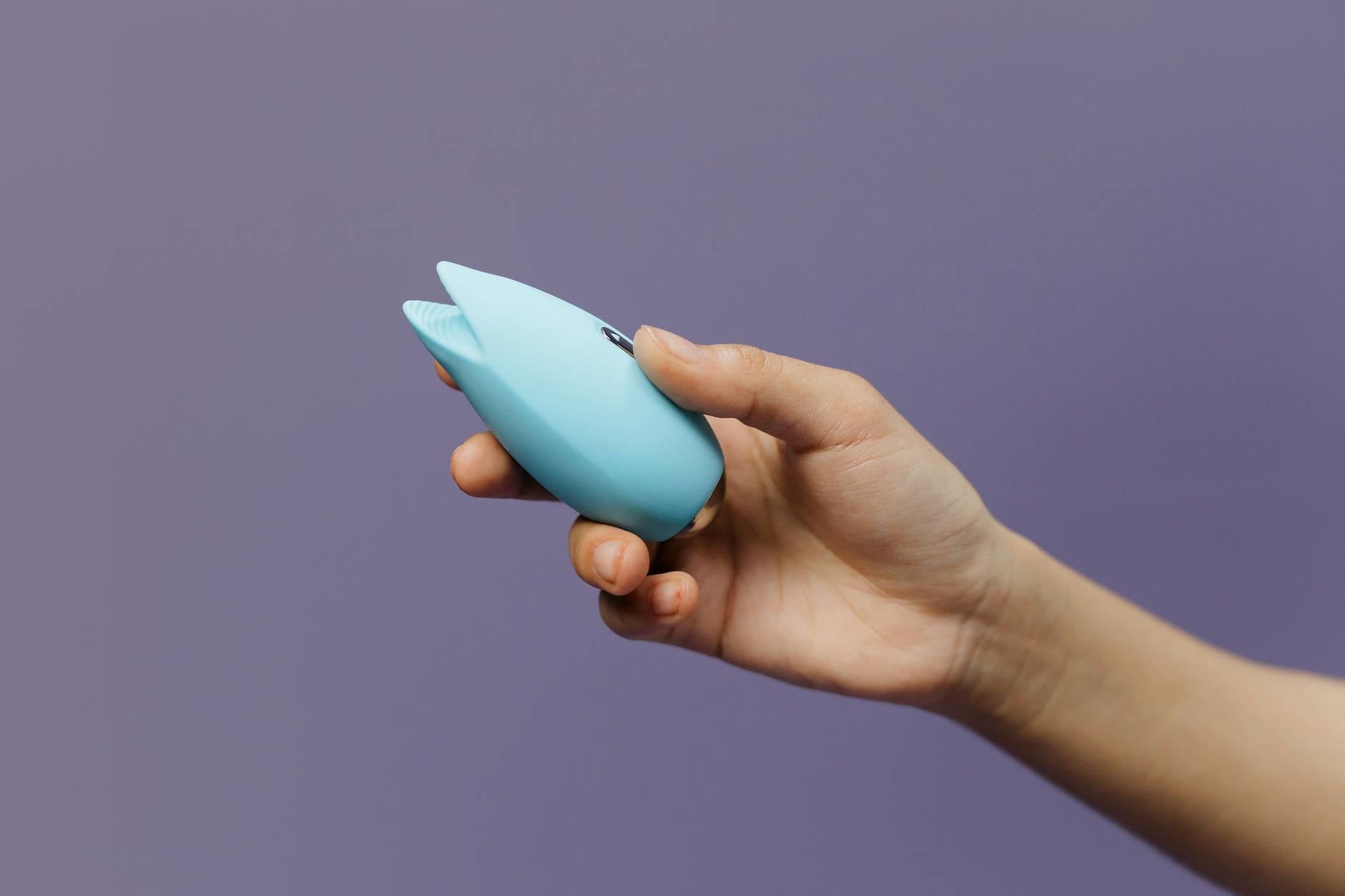
Here's the thing about bringing toys into partnered sex
It's not actually awkward. The awkwardness lives in your head before you say anything. Once the words are out, it's just logistics.
I've worked with hundreds of couples navigating this exact moment, and the pattern is always the same. One partner has been thinking about introducing a lemon vibrator (or any toy) for months. They've imagined the conversation a thousand times. They've catastrophized every possible rejection. Then they actually mention it, and their partner says, "Oh thank god, I was wondering when you'd want to try that." It's almost funny how often that happens. Not always, but often enough that it's worth saying out loud: you probably won't get the response you're afraid of.
The real work isn't the conversation. It's figuring out what actually works physically when you're not alone anymore. And that's what this is for.
Why couples reach for clitoral vibrators in the first place
Let's start with the obvious fact nobody says: most people with vulvas don't orgasm from penetration alone. The research is clear and consistent on this. Somewhere between 65 and 80 percent need direct clitoral stimulation. That's not a flaw. That's anatomy.
For years, the workaround was one partner using their hand while the other person was inside, which works fine but gets tiring for the hand-person. A lemon sucker or other clitoral vibrator removes that labor. It also means the receiving partner can relax into the sensation without worrying about their partner's arm getting tired. Both people get to actually enjoy it.
Beyond that practical math, there's pleasure math. A lemon clitoral vibrator creates a different kind of stimulation than fingers or a penis can. It's consistent, adjustable, and it hits different nerve endings. Adding it to partnered sex often means stronger orgasms, more consistent arousal, and frankly, less frustration on both sides.
The communication part (because it matters)
Here's how I'd frame it, and feel free to steal this exactly: "I've been thinking about trying something together. I love our sex. I also want to explore what feels good for my body in a new way. I found this toy I think might be fun to try together. Are you into that?"
Three things are happening in that sentence. You're affirming what exists ("I love our sex"). You're centering your own pleasure ("what feels good for my body"), which removes the implication that they're not enough. And you're making it collaborative ("together," "us"). That removes the threat that usually lives underneath this conversation.
If your partner says no, that's real information and worth a longer conversation about what's underneath it. Sometimes it's insecurity. Sometimes it's a different comfort level with toys. Sometimes it's logistics (pregnancy, medical reasons, recovery). None of those things mean the conversation is closed forever. But they do mean you get to understand what you're actually working with.
If they say yes (which is statistically likely), the next conversation is shorter: "So how do you want to use it? Do you want to hold it, or do I?"
Positioning and logistics that actually work
This is where theory meets reality, and theory loses.
The most common positions for using a lemon clitoral vibrator with a partner are these:
Receiving partner on top (their knees on either side of their partner's hips, facing their partner or away). This gives the receiving partner the most control over depth and angle. The receiving partner can also hold the vibrator themselves, which means they can adjust intensity and placement in real time. The giving partner's hands are free to touch their partner's back, chest, or hold their hips. This is the easiest position to start with because there's zero coordination required.
Receiving partner on their back with their partner between their thighs. The giving partner can enter while the receiving partner (or the giving partner) holds the vibrator against the clitoral area. This requires a bit more spatial awareness because everyone needs to adjust for the toy's position, but once you find the angle, it works. The giving partner can also lean forward to kiss while this is happening, which adds something nice.
Side-by-side or spooning position. This is underrated. You're both lying on your sides, the giving partner enters from behind, and the receiving partner (or giving partner, depending on arm length) holds the vibrator. It's intimate, less athletic, and honestly feels good if you're either tired, pregnant, or recovering from anything that makes other positions uncomfortable.
What doesn't work as well: positions where the receiving partner is face-down, or anything that requires the vibrator-holder to contort. You'll abandon it after thirty seconds because it's uncomfortable, not because the toy is bad.
The settings question
Most lemon vibrators have a few speeds. Start on the lowest setting. I know you think you want the highest setting. You don't. Lowest setting, build from there. The receiving partner should control the intensity because they can feel it and you can't. If you're holding the vibrator, your partner should absolutely tell you to turn it up, down, or move it.
Also: silence matters less with a partner. Most vibrators make noise. If you're both in the moment, you stop noticing it after maybe thirty seconds. If either of you is self-conscious about it beforehand, mention it once ("By the way, this makes some noise") and then don't think about it again.
What to do about the awkwardness that might still happen
Sometimes your bodies don't fit together the way you imagined. Sometimes the angle is off. Sometimes someone giggles because a limb falls asleep. Sometimes someone gets distracted thinking about the grocery list.
All of this is completely normal. Here's what you do: pause, adjust, or take a break. There is zero pressure to soldier through. If something's not working, stop, laugh, reset, and try again or try something else. The toy is a tool. You're not taking a test where failure counts.
Most couples I've worked with say that the second or third time they use a toy together is way easier than the first because everyone's already adjusted to the idea, and the coordination feels less foreign. You're not trying to manage a brand new sensation, a brand new communication dynamic, and physical logistics all at once anymore. You've already done the hard part just by trying once.
When to introduce it (timing matters more than you'd think)
Introduce toys when you're both relaxed and neither of you is stressed about other things. Not during a week when your partner is dealing with work chaos. Not when you're already frustrated about something unrelated. Pick a time when you both have space in your brain to actually focus.
Also, introduce it when your partner isn't already aroused. I know that sounds counterintuitive, but here's why: if you bring a toy into the conversation when someone's already in the middle of sex, they don't have the cognitive real estate to actually engage with the idea. The conversation gets tangled with physical sensation and there's no clean space to just talk about it.
Bring it up when you're clothed, relaxed, and have time. Then you can build up to actually using it together.
The thing about pleasure that changes everything
Using a lemon vibrator with a partner is not about fixing something broken. It's about expanding what's already good. You're not saying "our sex isn't working." You're saying "I want to explore this together." That's a completely different conversation, and it often strengthens the connection because you're prioritizing mutual pleasure over ego or fear.
Your partner wanting to introduce a toy into your sex life isn't a criticism. It's actually an invitation. They want to be with you in a way that feels good for both of you. That's the subtext worth paying attention to.
FAQ
Can we use a lemon vibrator if we're already happy with our sex life?
Yes. Absolutely. Adding a toy to sex that already works well doesn't fix anything because nothing is broken. It just expands the options. Think of it like this: you can be happy with your favorite restaurant and still want to try a new one sometimes. Both things can be true.
What if my partner is insecure about using a vibrator?
That insecurity usually comes from a single false belief: that the toy means they're not enough. That's worth addressing directly and separately from the toy itself. The conversation might sound like, "Using a vibrator isn't about replacing you. It's about a type of sensation my body responds to differently. You're still here, still involved, still the person I want to be with." Sometimes showing your partner research helps (the statistic that 65 to 80 percent of people with vulvas need clitoral stimulation for orgasm is particularly useful here). Sometimes it just takes time and repeated experience. But it's worth the conversation.
How do I know if I'm using it during sex correctly?
Your partner will tell you. If something feels good, they'll probably move closer to it or ask for more. If something's uncomfortable, they'll say so. The only "wrong" way is if it's causing pain or if someone's not enjoying it. Beyond that, there's no correct technique. Experiment.
Is it weird to ask my partner to hold it while we have sex?
Not weird. Practical. The receiving partner often has better positioning to hold it because they can feel exactly where it needs to be. And honestly, sometimes it's fun to let your partner manage the intensity because it frees up your body to just receive sensation.
What if we try it and it kills the mood?
Then you know that's not your thing, and you stop doing it. You can also try a different position, a different vibrator, or a different time. One awkward attempt doesn't mean you have to keep trying. But most couples find that the first time feels slightly off and the second time is much better. Give it two chances before you decide it's not for you.
How do I bring this up without sounding like I'm criticizing our sex?
Frame it around your own body, not theirs. "I want to explore what feels good for me" lands differently than "I need you to..." or "Our sex isn't..." You're making it about your pleasure, not about a deficit. That changes everything about how the conversation lands.
You don't need permission
Your pleasure matters. Your partner's pleasure matters. A lemon clitoral vibrator is just a tool that can help both of those things happen more easily. Using one doesn't mean anything is broken. It means you're curious. And curiosity in partnered sex is usually the beginning of something better, not the end of something good. That conversation is worth having.