The performance trap nobody talks about
Here's what I hear in my office more than almost anything else: "I can't enjoy it if I'm worried about whether they're enjoying it." That sentence, in some variation, shows up in about half my sessions. The irony is brutal. You want pleasure. You're actively trying to have pleasure. And the trying itself kills it.
This is performance pressure, and it's not a personal failing. It's a structural problem in how we've learned to relate to our own bodies, especially in partnered contexts. The moment someone else is watching, evaluating, or depending on your arousal to feel good about themselves, your nervous system shifts. You move from "I'm feeling this" to "Am I doing this right?"
Lemon vibrators, and specifically suction-based clitoral toys like the Lem, work differently for this reason than anything else I've seen.
Why suction changes the pressure dynamic
Let me separate two things: physical sensation from psychological load.
Suction toys work mechanically in a way that requires almost nothing from you. You position it, activate it, and it does the work. There's no technique to master, no rhythm to match, no "am I moving this right" running in the background. The device is generating the sensation, not you. This matters more than you might think.
When you're using your fingers or a partner is manually stimulating you, there's an implied back-and-forth. You're both, on some level, responsible for the outcome. Did I communicate what I wanted clearly enough? Are they getting tired? Should I speed this up or slow down? Even in the best relationships, that split attention lives in the nervous system.
A suction toy like a lemon clitoral vibrator removes that. The sensation is consistent, reliable, and entirely external. You're not steering it. You're not performing it. You're receiving it. That distinction is not small.
The body responds when the mind stops watching
There's solid neuroscience here. Your clitoris has about 8,000 nerve endings, and about 75% of them are concentrated in the external glans. That tissue is densely wired for sensation. But arousal doesn't happen in the clitoris alone. It happens in a conversation between your genitals, your nervous system, and your brain.
When you're monitoring your own performance ("Am I there yet? Should I be farther along?"), you're running a loop that engages your prefrontal cortex. The part of your brain that watches, judges, and problem-solves. The same part that worries. Arousal actually requires the opposite. It requires your prefrontal cortex to quiet down.
Suction-based stimulation, because it's so passive from your end, makes that quieting possible. You're not deciding anything. There's nothing to optimize. Your brain gets permission to stop working and just experience.
Women and people with vulvas who've spent years feeling like "bad" at sex or "not orgasmic enough" often find that suction toys work where everything else failed. Not because their bodies were broken. Because for the first time, they weren't being asked to perform.
The psychological permission piece
Solo pleasure with a lemon vibrator does something else, too. It gives you information.
When you spend time alone with your own pleasure, using a tool that works for your body specifically, you learn what actually turns you on. Not what you think should turn you on. Not what your partner needs. Not what the culture says should work. What actually works for you, in your body, in this moment.
That information is power. I've watched clients shift from "I can't come" to "I can come very reliably with suction, but I need quiet and time." That's not a problem. That's data. Once you know that about yourself, you can ask for it. You can create conditions for it. You stop blaming yourself for not functioning like someone else's body.
And honestly, that knowledge often improves partnered sex, not as a goal but as a side effect. When you know what works for you and you've removed the shame from that knowledge, you become a better communicator. You can guide a partner. You can ask for what you need. You're not waiting for them to figure you out. You're not performing being figured out.
When you're ready to share this with a partner
Many people use lemon vibrators solo first. That's completely valid, and there's no timeline for moving beyond that. Solo pleasure is real pleasure, full stop.
But some people eventually want to integrate it into partnered sex. That's also valid. The way to do that without recreating the performance pressure is simple: reframe it.
The suction toy isn't a band-aid for your partner's inability to pleasure you manually. It's not you opting out of partnered sex. It's you bringing a tool that works for your body into shared space. It's the same way someone might bring a vibrator into partnered sex, except that the lemon vibrator's particular magic is that it can work alongside penetration, alongside manual stimulation, alongside almost anything else without creating conflicting sensations.
The conversation goes: "This works really well for my body. I want to have this during sex with you." Not: "Your hands aren't doing it." The shift is from critique to inclusion. Your partner gets to watch what actually brings you pleasure. They get to be present for your orgasm in a new way. Many couples find that immensely intimate.
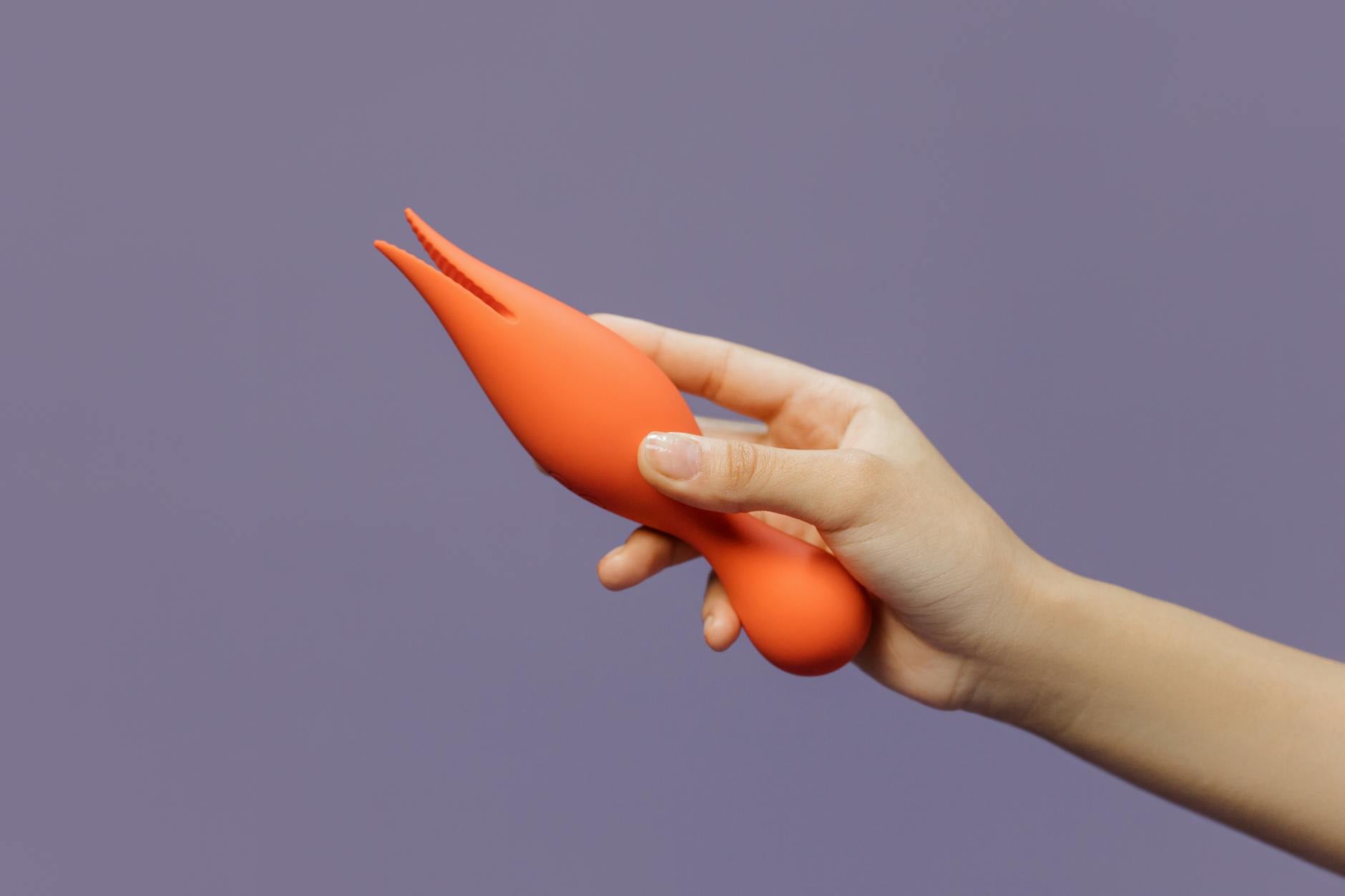
Photo by cottonbro studio on Pexels
The practical setup that actually kills pressure
If you're exploring solo pleasure with a lemon vibrator, the environment matters. Not in a romantic-lighting way, but in a "remove distractions" way.
Your nervous system needs permission to relax. That means your phone is in another room. That means you're not half-listening for a partner to come home. That means you have enough time that you're not watching the clock.
Different patterns matter too. Most lemon vibrators, and the Lem specifically, offer multiple settings. Start on a gentler pattern. You're not racing to orgasm. You're experimenting with sensation. Some days you'll love pattern three. Other days pattern one feels better. There's no right answer.
One thing I tell clients: if you find yourself thinking "this should be working by now," you've slipped back into performance mode. Pause. Breathe. Reset the goal from "have an orgasm" to "experience sensation without judgment for ten minutes." Often the orgasm shows up when you stop waiting for it.
When solo pleasure shifts something bigger
There's a reason that learning to use lemon vibrators when you're just starting out with toys changes how people move through the world. It's not just about the sensation. It's permission.
Your pleasure is not a performance. It's not something you owe anyone. It's not something you should feel guilty about or rushed through. The moment you experience orgasm that came from following your own body's lead, not anyone else's script, something shifts.
Many people find that dissolves a ton of the performance pressure in partnered contexts too. Because you know, in your body, that you're capable of pleasure when the conditions are right. You're not defective. You're not broken. You're just someone who needs specific things. And that's completely normal.
If you've been wanting stronger orgasms but worrying about overstimulation, suction toys let you explore that without the constant feedback loop of "is this too much?" You get to feel what intensity actually feels like in your body. You get to discover where your edge is, without anyone watching you find it.
FAQ: Pressure, pleasure, and what works
What does "performance pressure" actually feel like in your body?
Performance pressure shows up as distraction, tension in the pelvic floor or jaw, difficulty with arousal progression, or feeling "present" in your head but disconnected from sensation. Some people describe it as that nagging voice saying "is this happening yet?" Others feel it as physical tension that won't release. The exact sensation varies, but the core is: your attention is divided between experiencing pleasure and monitoring whether you're doing it "right."
Can using a lemon vibrator alone actually improve partnered sex?
Frequently, yes. Not automatically, and not as a magic fix. But when you learn your own body's response patterns in a low-pressure context, you gain information you can share with a partner. You also often experience relief from the burden of "figuring yourself out" during partnered sex, which frees up mental bandwidth for actual connection. The suction toy isn't the change. The knowledge is.
What if my partner feels threatened by me using a toy alone?
That's a conversation worth having directly. "I'm exploring my own body and what feels good for me" is a completely reasonable boundary. If a partner sees your solo pleasure as a threat rather than information, that points to something larger about how they relate to your autonomy. A therapist or counselor can help navigate that dynamic, because your pleasure deserves to exist without justification.
Is there a difference between a lemon vibrator and other clitoral vibrators when it comes to reducing pressure?
Yes. Suction toys specifically remove the friction-based stimulation that requires more active engagement. You're not moving it, angling it, or finding the perfect spot. The seal and suction do the work. That hands-off quality is part of why they reduce performance pressure so effectively. Other vibrators are wonderful, but they work differently.
How long should I spend exploring before I feel comfortable with my own pleasure?
There's no timeline. Some people click with suction toys immediately. Others need a few sessions to trust the sensation and quiet the watching part of their brain. There's no "right" amount of time. What matters is that you're spending time in your own pleasure without a goal beyond experiencing it.
What if I never want to share this with a partner, and that's okay?
Completely okay. Your pleasure doesn't need to involve anyone else. Solo pleasure is real pleasure. If you're partnered and you want to keep this aspect private, that's your boundary to set. Your pleasure is yours first.
Moving toward pleasure on your terms
Performance pressure is real and it's everywhere. It's in how we learned to think about our bodies, how we navigate relationships, how the culture frames female pleasure as something that needs to be achieved or earned. Breaking that pattern doesn't happen in a conversation. It happens in the body, over time, when you give yourself permission to experience sensation without narration.
A lemon vibrator is just a tool. But the right tool, in the right context, can help you access something you've maybe never experienced: pleasure that's entirely yours. No judgment. No watching. No performing. Just your body, doing what feels good, on your timeline.
If you're ready to explore further or talk through how this might fit into your specific situation, reach out. That's what I'm here for.